
Of all the definitions out there, I believe my view of the world falls closest to that of a “Realist.” The dictionary definition is “a person who tends to view or represent things as they really are.” (www.reference.com) In contrast, it seems that in western society there is a trend pushing people to believe that they should take a “glass half full” approach to life which by definition is that of a “Optimist.” An optimist, by definition, has “a disposition or tendency to look on the more favorable side of events or conditions and to expect the most favorable outcome.” Certainly there is something to be said for the power of denial and refusing to acknowledge pain, suffering and stress. As they say, “ignorance is bliss” and those that choose to only see happiness tend to happier.
 I’ve spent some time pondering the pros and cons of Realism versus Optimism and I’m unsure which really provides for a healthier and more fulfilling lifestyle. Ultimately I lean toward the Buddhism approach to life where effort is put into a balance of the “Middle Way.”
The Buddha himself was born a prince, and so had been showered with luxury since childhood, however, he soon realised that true happiness was not to be found in luxury and so went to practise or experiment with the practices of self-mortification, as a forest dwelling ascetic. However, during his six years as an ascetic, he found those practices, too, to be empty of true happiness. While he practised these, he knew that both of these approaches were too extreme. He realised that self-indulgence was utter materialism and self-mortification was utter spiritualism, so then he balanced these two extremes into the middle way, giving importance to both mind and matter, because when they work together, interdependently it is very powerful. He called this path of balance between the two extremes, the Middle Way. All things depend on the truth of cause and effect as is explained in the Buddha’s second noble truth; everything arises because of a cause. Since there is a cause, there is an effect which is related to its cause. According to Paticasamuppada (the law of cause and effect), the Buddha taught that all phenomena arise interdependently as the causes always give rise to effects. All things are inter-related, they cannot arise independently. This is called the Middle way in the Buddhist sense. (www.buddhapadipa.org)
From this we can take away that all things are related. You cannot have happiness without sorrow, or good without evil, or even shadow without light. Both are necessary in order to have existence of the other. There is a significant amount of effort put into trying to see “reality of things as they really are.” Living a life of the middle way is following the Eight Fold Path outlined by Buddha:
Eightfold Path
- right view –> awakened view
- right intention –> awakened intention
- right speech –> awakened speech
- right action –> awakened action
- right livelihood –> awakened livelihood
- right effort –> awakened effort
- right mindfulness –> awakened mindfulness
- right concentration –> awakened concentration
Personally, I feel I strongly the word “right” is perhaps a misleading translation of the original Sanskrit. I tend to lean toward Lewis Richmond’s translation of “right” in preference of “awakened view, awakened intention, etc”. Lewis writes:
The eightfold path is usually translated as a series of “rights”: right view, right intention, right action, right speech, right livelihood, right effort, right mindfulness, and right meditation. I am not fond of the word “right” in this context. To my ear there is something self-righteous, judgmental, even arrogant in it, especially when compared with other faiths. I prefer to simply say: Buddhist view, Buddhist intention, and so on. Another possibility is to use the word “awakened”: awakened view, awakened intention, and so on. The Sanskrit samma–usually translated as “right”–means correct or appropriate; it doesn’t mean right as opposed to wrong. In the Zen tradition there is this story. A monk once asked Chinese Master Ummon, “What is the work of the Buddha’s whole life?” Ummon replied, “An appropriate response.” Ummon may have been speaking of awakened character–the work of a person’s whole life. The person of wisdom responds to each situation appropriately in the light of awakening. That was the Buddha’s whole life, Ummon says, and that should be our whole life too. (www.huffingtonpost.com)
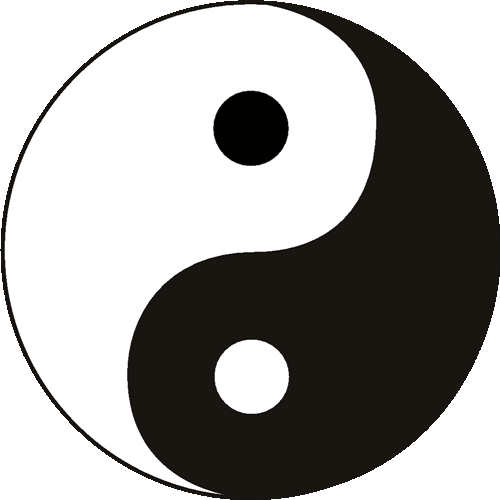
Perhaps the most famous Asian symbol known in the west is that of the Yin and Yang. “in Chinese philosophy and religion) two principles, one negative, dark, and feminine (yin) and one positive, bright, and masculine (yang) whose interaction influences the destinies of creatures and things.” (www.reference.com). The yin and yang symbol is applied to opposites in many different areas: male vs female, black vs white, good vs evil, suffering vs joy. It can also be applied to world views of optimism vs pessimism. I believe the first principle of the eightfold path applies to yin and yang and seeing both sides to all situations. Instead of seeing the glass as half full or empty, it is seeing the balance of both aspects. I see this as an “awakened view” of reality. It is not an optimistic or pessimistic view, but rather a realist view of the world around me. I feel it is balanced and holds true to the spirit and intent of viewing the world by principles of the middle way.
