
In a new book The Mathematical Universe: My Quest for the Ultimate Nature of Reality, physicist Max Tegmark argues that the universe and reality is in actuality just math. He is not saying that things can be described in a mathematical way, but rather that our very existence is math; that reality around us is just flying numbers. Tegmark’s mathematical universe hypothesis (MUH) is: Our external physical reality is a mathematical structure. That is, the physical universe is mathematics in a well-defined sense, and
“in those [worlds] complex enough to contain self-aware substructures [they] will subjectively perceive themselves as existing in a physically ‘real’ world.”
 The first step into deep water is the easiest. If space is infinite, our visible Universe can be regarded as a bubble within that infinite space, analogous to the bubble of visibility surrounding a person walking through a fog. It is possible to calculate the number of particles (neutrons, protons and the like) in that bubble, and to calculate the number of ways they could be arranged. This is an enormous number but, crucially, it is not infinite. So in infinite space, there must be other bubbles – other universes – with exactly the same arrangement of particles as in our Universe. This is the Type I multiverse, and it is almost common sense.
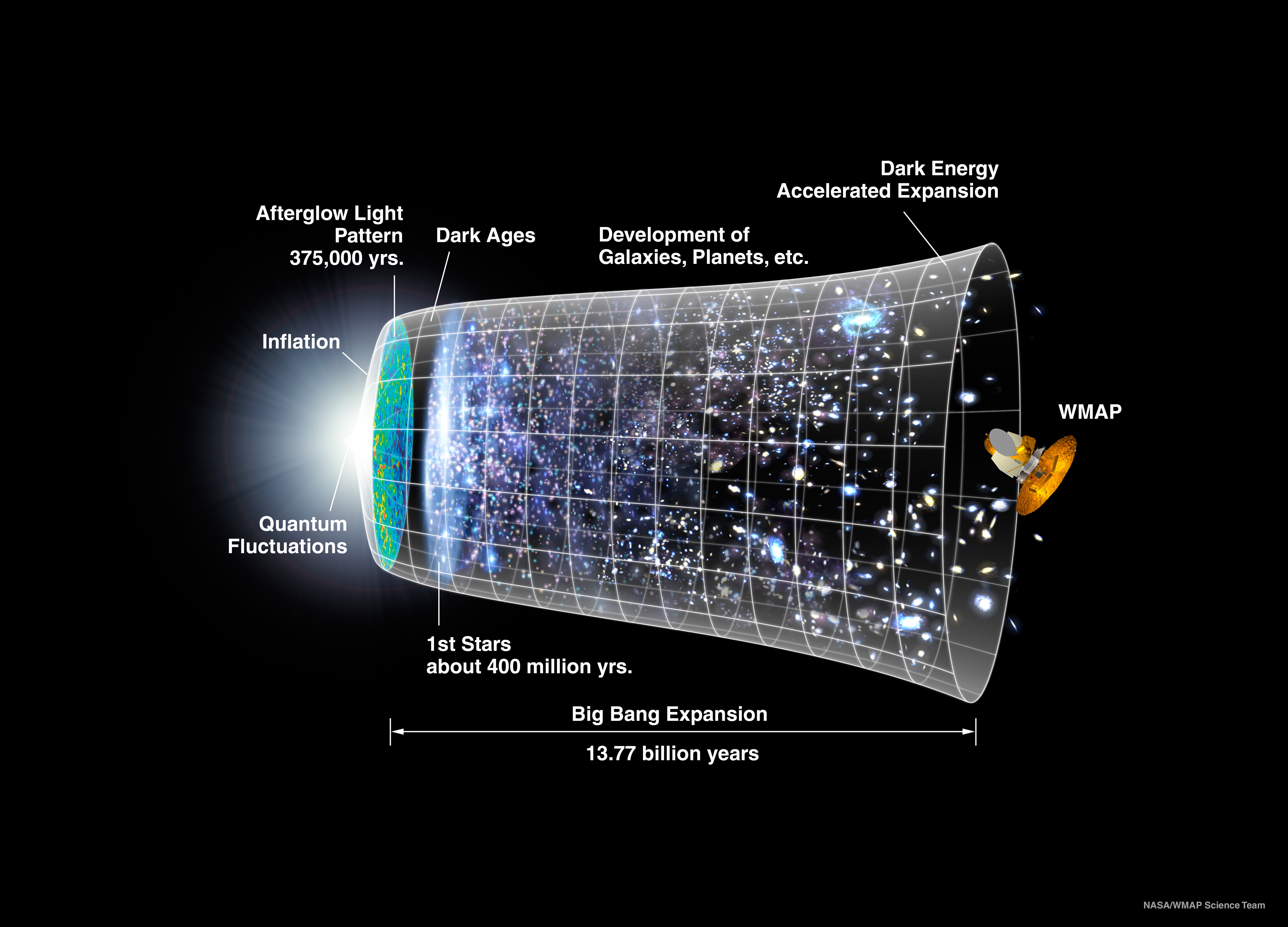
The Type II multiverse is only slightly more complicated. It takes on board the currently favoured idea of inflation, which explains the present appearance of our Universe as resulting from an epoch of very rapid expansion at the time of the Big Bang. Each universe is an inflating bubble within some kind of superspace. But it is the Type III multiverse that is familiar from science fiction.
Atomic Particles with Mathematical Values
All matter is made up of particles, which have properties such as charge and spin, but these properties are purely mathematical, he says. And space itself has properties such as dimensions, but is still ultimately a mathematical structure. One of the examples Tegmark provides is removing names from atomic elements such as electrons, quarks and positrons. Instead, he looks at these same particles in terms of how they exist in the mathematical model.
Spin quantum number
 As the name suggests, spin was originally conceived as the rotation of a particle around some axis. This picture is correct so far as spin obeys the same mathematical laws as quantized angular momenta do. On the other hand, spin has some peculiar properties that distinguish it from orbital angular momenta:
- Spin quantum numbers may take half-integer values.
- Although the direction of its spin can be changed, an elementary particle cannot be made to spin faster or slower.
- The spin of a charged particle is associated with a magnetic dipole moment with a g-factor differing from 1. This could only occur classically if the internal charge of the particle were distributed differently from its mass.
- The conventional definition of the spin quantum number s is s = n/2, where n can be any non-negative integer. Hence the allowed values of s are 0, 1/2, 1, 3/2, 2, etc. The value of s for an elementary particle depends only on the type of particle, and cannot be altered in any known way (in contrast to the spin direction described below). The spin angular momentum S of any physical system is quantized. The allowed values of S are:
- S = \frac{h}{2\pi} \, \sqrt{s (s+1)}=\frac{h}{4\pi} \, \sqrt{n(n+2)},
- where h is the Planck constant. In contrast, orbital angular momentum can only take on integer values of s, even values of n.
Yin and Yang Mathematics
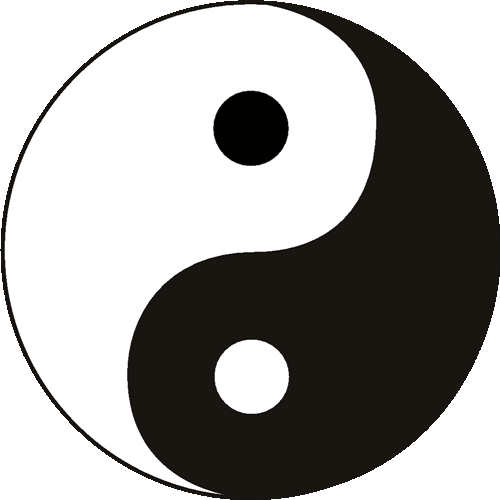 In a odd twist of parallel logic, eastern philosophers of Buddhism have been arguing much the same thing with the core concepts of reality being based on Yin and Yang. This is basically binary mathematics of zero = yin and one = yang. Binary systems predating Leibniz also existed in the ancient world. The I Ching that Leibniz encountered dates from the 9th century BC in China. The binary system of the I Ching, a text for divination, is based on the duality of yin and yang. Leibniz interpreted the hexagrams as evidence of binary calculus. He said that “this arithmetic by 0 and 1 is found to contain the mystery of the lines of an ancient King and philosopher named Fuxi, who is believed to have lived more than 4000 years ago, and whom the Chinese regard as the founder of their empire and their sciences.” The text contains a set of eight trigrams (Bagua) and a set of 64 hexagrams (“sixty-four” gua), analogous to the three-bit and six-bit binary numerals, were in use at least as early as the Zhou Dynasty of ancient China. The residents of the island of Mangareva in French Polynesia were using a hybrid binary-decimal system before 1450. Slit drums with binary tones are used to encode messages across Africa and Asia. The Indian scholar Pingala (around 5th–2nd centuries BC) developed a binary system for describing prosody. He used binary numbers in the form of short and long syllables (the latter equal in length to two short syllables), making it similar to Morse code. Pingala’s Hindu classic titled Chandaḥśāstra (8.23) describes the formation of a matrix in order to give a unique value to each meter. An example of such a matrix is as follows (note that these binary representations are “backwards” compared to modern, Western positional notation):
- 0 0 0 0 numerical value 110
- 1 0 0 0 numerical value 210
- 0 1 0 0 numerical value 310
- 1 1 0 0 numerical value 410
In the 11th century, scholar and philosopher Shao Yong developed a method for arranging the hexagrams which corresponds, albeit unintentionally, to the sequence 0 to 63, as represented in binary, with yin as 0, yang as 1 and the least significant bit on top. The ordering is also the lexicographical order on sextuples of elements chosen from a two-element set.
