
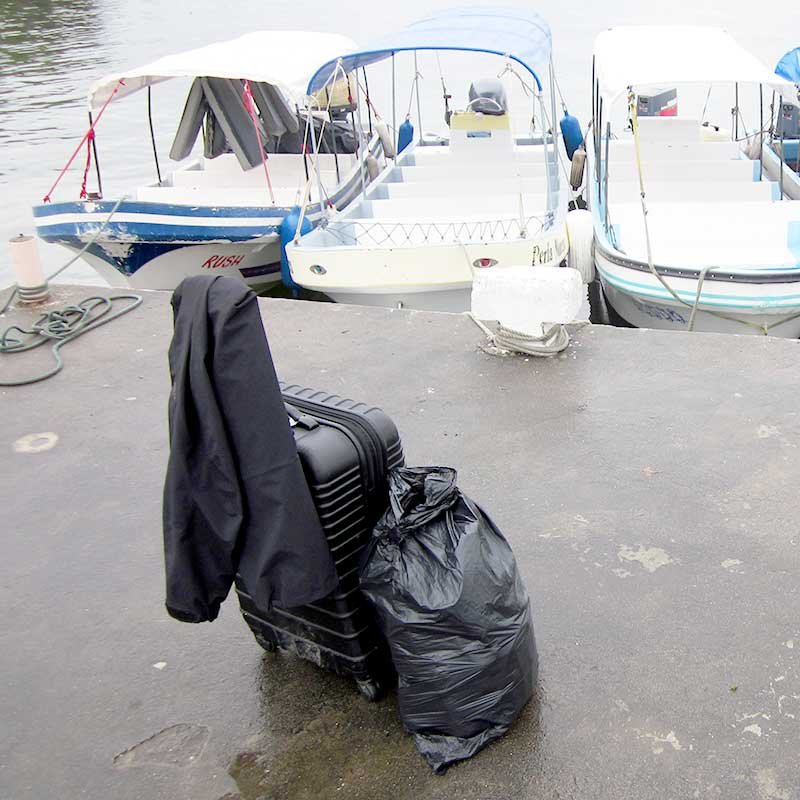
My travel set of suitcase with computer backpack (in a plastic bag to protect it from water while in the boat). My jacket is hanging on the extended tow arm of the suitcase.
One of the core concepts of 7ism is simple living. I apply simple living to all aspects of my life from my physical possessions to my daily to-do list. It is an all encompassing principle in my life centered around reduction of having or doing too much.
Reduction of Physical Belongings
Over the past several years I have been reducing the amount of physical belongings I have. In 2010 I owned a four bedroom house completely full of stuff. I had so much stuff it took the largest Penske truck to move everything to my home in Denver. Perhaps it is a habit among Americans to collect and amass belongings, something it seems the reality TV shows are making into a popular topic with shows like “Hoarders.” Since that time I have sold my home, and sold or donated all my belongings down to just the things I use on a daily or weekly basis, all of which can fit into a medium suitcase in combo with a mid-sized computer back pack. As a result of this huge reduction in belongings, I feel as though an anchor and weight has been removed from my life. I have less to take care of and maintain. I no longer spend two hours mowing a big lawn, trimming bushes and vacuuming floors. My quality of life seems far simpler, less complex and happier.
Doing Less (While Having a Higher Quality Focus)

On the mountainside overlooking the pools of Semuc Champey in Northern Guatemala.
It is amazing to me how less stressed I am in my life by just doing less. In around 2009 or 2010 I read a life-changing book by Tim Ferriss called the “4 Hour Work Week.” I believe the title is an overstatement and a marketing gimmick, but overall the book contains some life altering advice regarding what Ferriss calls “life style crafting.” I’m guessing this term was common before Ferriss, but to me it was a new concept centered around making a “bucket list” of things you want to do before you die and things you value in life as well as a list of things that are stressful in your daily living. After having the two lists, designing a life to reduce the stressful items and focus on those items of true value for day-to-day living. One of the common items on many people list is to reduce the time working and increase time in recreational activities like sports, hobbies and travel. It is from this line of thought the book is titled as the “4 Hour Work Week.” For almost the first 20 years of my business I forced myself to be up, showered, dressed an “in the office” by 9am. I would then “stay in the office” until 5pm. Most days when I didn’t have client work or things that needed to be done, I’d research work related topics. I felt it was necessary discipline to stay “in the office” or doing work related activities for the entire 9 to 5 day (excepting lunch and short breaks). In a nut shell, I was “punching the clock.” This is all good and well for self discipline. However, after reading Ferriss’ book, I began to see things in a different light. Perhaps a better set of habits would be to create a list of essential “must do” items for each day and then work hard each morning to accomplish the list within a few hours time, then take my lunch. Most afternoons there would be nothing left which “needed” to be done. The big question, as Ferriss points out, is what to do with this extra time. If you only worked four or eight hours a week, what do you do with the rest of your time? This is where the book by Ferriss shines. His suggestion is to pursue your passions, those items on your bucket list. For some that may be improving their tennis game, for others it is learning a language or international travel. I have worked hard to try to reduce my work related to my business to the absolute essentials and to accomplish those select tasks as efficiently as possible. I try to limit my work tasks to three or four (or less) tasks per day so I can do them well and pay closer attention to my work. In the afternoons, I try to focus on one or two tasks that I’m passionate about. These may include study, travel, or socializing. As a result of this revised schedule and new list of priorities, I feel a much greater sense of calm and a higher degree of happiness.
Less Stress
For the most part, my revised lifestyle of having and doing less seems to be the best form of stress-free living that I’ve found. I have less in the way of physical belongs to maintain and worry about. This means less in the way of bills and financial obligations and more free time and money to pursue my passions and dreams. By reducing my list of activities and tasks to the essentials, my work is completed faster and my recreational activities are chosen carefully to be those of higher meaning in life. The combination of these two factors has led to my current lifestyle of greater freedom and happiness.

January 5, 2014
I admire that you have been so successful with your plans, Seven. You mention discipline and I think you have shown an even greater discipline and courage in putting aside habits and society norms then you ever would have in the office.
January 5, 2014
wren, thanks for your kind words and comments. I think the same could be said of you in the past couple years! 😉